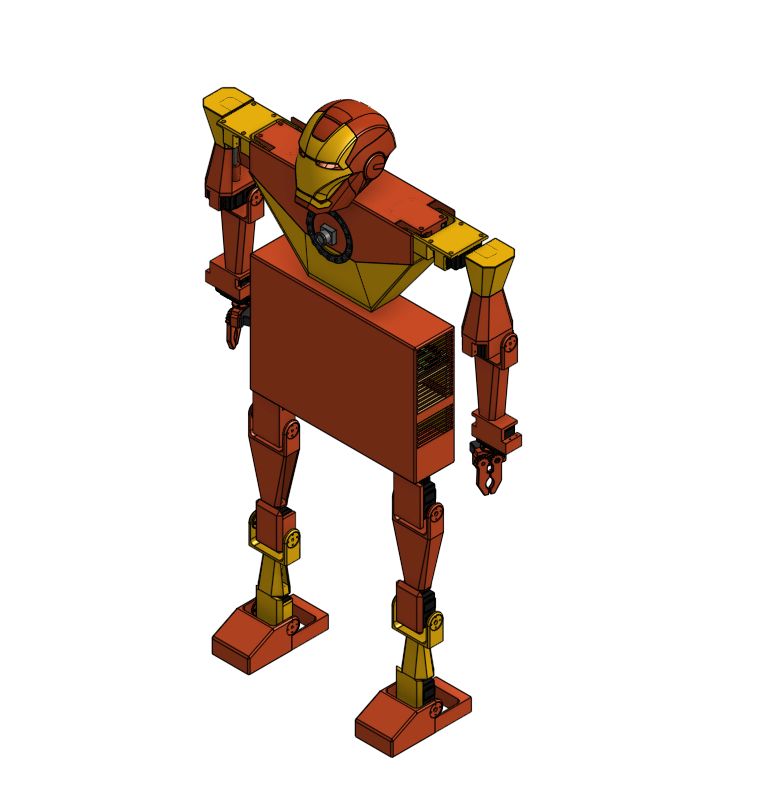
What it is
This is perhaps my most ambitious project yet: a fully autonomous humanoid robot, which I'm building with my team of 3 other members. With no one touching it, it has to follow a black line across a 6 × 6 m mat, take the right branch at junctions, wait for or walk around moving obstacles, climb ramps, cross a narrow bridge, get through a dark tunnel and finally stop on a tagged destination.
Why
We're building for Gujarat Robofest 6.0. But with that, it's also a body I want GOFI to drive later.
How it works
Before any CAD, I designed the frame with weight estimates, so I could calculate the maximum torque each joint would need. That decided everything after it. Stark is 3D-printed, about 56 cm to the shoulders and 3.5 kg. Each leg has six joints: three at the hip, one at the knee and two at the ankle. That's twelve hobby servos, and each one sits behind a printed gearbox that multiplies its torque by 2.4 to 4.5 times.
The torso is, naturally, an Iron Man-style shell (the name probably gave that away). It holds the battery, a Raspberry Pi 5, an Arduino and the power electronics, with a ring light in the chest as the arc reactor and a camera in the middle of it.
Its brain works in two layers. The bottom one is the walking skill: a small neural network, trained with reinforcement learning, that runs 50 times a second and keeps it upright using only an IMU and eight pressure sensors in its feet. The top one is navigation: plain computer vision finds the line and reads the junction signs, then tells the walking skill how fast to go and which way to turn. Reinforcement learning was new to me when we started, so I've been learning it as I build.
The CAD
Rather than drawing every part by hand, I wrote one Python script that drives Fusion 360 and builds the whole robot. If I change a servo or a screw length, it rebuilds every part around it, checks that everything still fits, and exports 130 print-ready parts, each small enough for a 180 mm printer.
That saved us more than once. When the knee servo went out of stock, the new one went in and everything around it was rebuilt in one run. The arms and the face aren't in it yet; they come at the end.
Where it's at
We qualified in the ideation stage, securing Rs. 25,000 from GUJCOST. Since then, everything's been designed, and it walks, though only in simulation so far. In MuJoCo it still walks with every servo cut to 40% of its torque. Across fully randomised walks, where the masses, servos, terrain and pushes all change, the walking skill stays up about 72% of the time, against about half for the walker I wrote by hand. It can turn, wait by marching in place, and handle ramps, small humps and the bridge. Steep humps are the one problem I'm still stuck on.
With navigation on top, it walked last year's 11.7 m course to the end in 8 out of 8 randomised runs without falling. It never took a wrong branch in 64 junction runs, and in 41 of 42 runs with obstacles it didn't touch a single one.
Next up are the tunnel and the destination tag. Then we order the parts (the list comes to Rs. 27,015, a little over our Rs. 25,000), print, and build the real one before the competition on 18 December.
Links
We can't share any of what we've made until after the competition.